
Screen protector types: what 9H, 2.5D, 3D and 5D mean
What the 9H, 2.5D, 3D and 5D markings mean, how tempered glass, flexible glass and films differ, and how to choose the right protection for your phone.
In short
- 9H – the highest hardness rating in the pencil test: the glass resists everyday scratches.
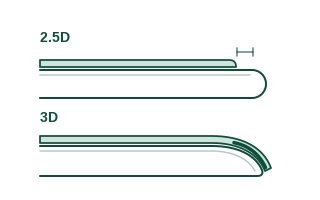
- 2.5D – flat glass with rounded edges. It covers the flat part of the screen and works perfectly with a case.
- 3D and full-coverage protectors cover the screen right up to the edge, usually with a black border.
- 5D, 9D, 11D or 21D usually means full-coverage glass with rounded edges.
- Full glue – adhesive across the entire surface of the glass, so the glass sticks firmly to the screen.
- Flexible glass and films are ideal for curved screens.
9H: scratch resistance
9H is the highest grade on the pencil hardness scale. In the test, the surface is scratched with progressively harder pencils, from the softest, 6B, to the hardest, 9H. Not even the hardest pencil scratches 9H glass, so keys, coins and other things in your pocket are no threat to it in everyday use.
When a phone is dropped, the screen protector absorbs part of the impact. Even if it cracks, the screen usually stays intact, and replacing the protector is inexpensive.
2.5D, 3D and 5D: the shape of the edge
2.5D – rounded edges
“2.5D” means that the edges of the flat glass are ground to a gentle curve, so they are pleasant to the touch and less likely to chip. This type of glass covers the flat part of the screen and leaves a gap of about a millimetre at the edge. That way the edges of a case do not press against the glass, and the two work perfectly together. Protectors like this are often called “case friendly”.
3D – curved to fit the screen
3D glass is pre-curved to match the edges of the screen, so it is meant for phones with a curved display. It covers the whole front and usually has a black border around the edge that hides the adhesive line.
5D, 9D, 11D and 21D
These names are most often used for full-coverage protectors with a black border and rounded edges. They are not standardised, so when choosing it is worth checking three things: whether the glass covers the screen right to the edge, whether the adhesive covers the whole surface, and whether it is made specifically for your model.
Tempered glass, flexible glass or film
Each type of protection has its own strengths, so it is worth choosing based on your phone and your habits.
Tempered glass
The most popular type of protection: hard, clear and as smooth as the screen itself. It comes as 2.5D, full-coverage, 3D and UV glass.
Pros
- Highly scratch-resistant (9H).
- Feels like the real screen, and your finger glides easily.
- Absorbs part of the impact in a drop and protects the screen.
Worth knowing
- Rigid glass does not bend, so it may not sit flush against rounded or curved screen edges. For screens like these, 3D or UV glass, flexible glass or a film is a better fit.
- 9H protects against everyday scratches, but harder particles such as sand can leave marks over time.
Flexible (hybrid) glass
Flexible glass, such as 3mk FlexibleGlass, is a combination of film and glass with a hard coating. It bends slightly, so it sits well against rounded edges, and the versions made for curved screens also cover the curved edge.
Pros
- Does not shatter into shards or chip at the edges.
- Thin, about 0.2–0.3 mm, so you can hardly feel it.
- Sticks well to rounded edges.
Worth knowing
- Its hardness is usually 7H, so it scratches more easily than tempered glass.
- The surface is softer and not as smooth as tempered glass.
Protective film
Films are soft and flexible, so they can cover even sharply curved screens and watch screens.
- Hydrogel and TPU film covers the screen right up to the edge and works with most cases. Fine scratches in it smooth out within a few hours.
- Films for curved screens, such as 3mk ARC, are thin, about 0.17 mm, and go on with a mounting gel, so you can adjust their position before they stick.
- Matte films reduce reflections and fingerprints, which makes them handy in sunlight and for gaming.
Pros
- Covers curved edges and watch screens.
- Does not lift, break or get in the way of a case.
Worth knowing
- Gives less impact protection than glass.
- The soft surface wears faster, so the film needs replacing more often.
Extra features
- Privacy glass or film: only the person looking straight at the screen can see the image; to people nearby, at an angle of about 30° or more, the screen looks dark. The whole screen also becomes slightly darker, so you can turn up the brightness.
- Matte finish: fewer reflections and fingerprints, handy in sunlight and for gaming.
- A blue light filter (anti-blue) gives the image a warmer, yellowish tint, which many people prefer in the evening.
- UV glass is applied with liquid adhesive that is cured with a UV lamp (supplied in the kit). The adhesive fills the whole gap, so the glass holds firmly even on curved screens and usually does not interfere with an in-display fingerprint reader.
- Camera lens protector – a separate small piece of glass for the camera lenses. Choose one made for your exact model so that it lines up perfectly with the lenses.
Comparison
| Type | What it covers | Scratch resistance | With a case | Best for |
|---|---|---|---|---|
| 2.5D tempered glass | The flat part of the screen | Very good (9H) | Excellent | Flat screens, if you use a case |
| Full-coverage glass (5D, 9D, etc.) | The whole front, with a border | Very good (9H) | Choose “case friendly” | Protecting the screen right to the edge |
| 3D and UV glass | The whole screen, including the curved edges | Very good (9H) | With most cases | Curved screens |
| Flexible (hybrid) glass | The flat part or the whole screen | Good (usually 7H) | Excellent | Rounded edges |
| Hydrogel or TPU film | The whole screen, even the curved edges | Protects against minor scratches | Excellent | Sharply curved screens, watches |
How to choose: five questions
-
What is your exact phone model?
Protectors for the Galaxy S25, S25+ and S25 Ultra are not interchangeable. You will find the exact model name in your phone’s settings, under “About phone”.
-
Is the screen flat or curved?
For a flat screen, choose 2.5D or full-coverage glass. For a curved one, choose 3D or UV glass, flexible glass made for curved screens, or a film.
-
Do you use a case?
A “case friendly” protector works best with a thick case or one with high edges.
-
Is the fingerprint reader in the screen?
For ultrasonic readers, which are fitted in many Samsung Galaxy S models, choose glass that is labelled as compatible with the reader and has adhesive across the whole surface, or choose UV glass. Once the glass is on, register your fingerprint again.
-
What else matters to you?
For privacy, choose privacy glass. For fewer reflections, choose matte. For protection that will never shatter, choose flexible glass or a film.
Frequently asked questions
What is the difference between 5D, 9D and 21D glass?
These are different manufacturers’ names for full-coverage protectors with a black border. When choosing, what matters most is whether the glass covers the screen right to the edge, whether the adhesive covers the whole surface and whether it is made for your model.
Why is the glass smaller than the screen?
A 2.5D (“case friendly”) protector deliberately covers only the flat part of the screen, so that it fits under a case and the case does not lift its edges. If you want to protect the screen right to the edge, choose full-coverage glass with a black border.
Which glass is right for a curved screen?
For a curved screen, the right choice is 3D or UV glass, flexible glass made for curved screens, or a film. They follow the shape of the screen and cover it right to the edge.
Why do the edges of the glass lift or look white?
Usually because the screen has rounded edges and tempered glass does not bend. The edges can also be lifted by the raised edge of a case or by dust trapped under the edge. Gently press the edge down through a microfibre cloth. If the glass still will not stick, choose a “case friendly” protector, flexible glass or a film.
Does a screen protector interfere with the fingerprint reader?
It usually does not affect an optical reader. For an ultrasonic reader, choose glass that is compatible with it and has adhesive across the whole surface, or UV glass, and register your fingerprint again once the glass is on.
What thickness of glass is best?
Most tempered glass protectors are about 0.3 mm thick – a good balance between protection and comfort. Thicker glass absorbs impacts better, while flexible glass and films are thinner, about 0.15–0.3 mm.
Can 9H glass be scratched?
Everyday items such as keys or coins do not scratch 9H glass. Harder particles, such as sand, can leave marks over time. A scratched or cracked protector is inexpensive to replace, and the screen underneath stays intact.
To learn how to apply the glass without bubbles, see our guide “How to apply a screen protector”.